Table Of Content
We will construct a statistical test by decomposing the variation of theresponse. The basic idea will be to check whether the variation between thedifferent treatment groups (the “signal”) is substantially larger than thevariation within the groups (the “noise”). We can visualize the data by plotting weight vs. group (a so-calledstrip chart) or by using boxplots per level of group. This means that the first experimental unit will get treatment \(B\), thesecond \(D\), and so on. For example, say that you add a diet treatment with two conditions in addition to the training. Combined with the three versions of training, there are six possible treatment groups.
What is unlimited graphic design?
While CRD's simplicity and flexibility make it a popular choice for many research scenarios, the optimal design depends on the specific needs, objectives, and contexts of the study. Researchers must carefully consider these factors to select the most suitable research design method. While CRD may sometimes necessitate larger sample sizes, the improved accuracy and consistency it introduces to results often justify this requirement. An advantage of the restricted mixed model is that 2 observations from the same random factor b level can be positively or negatively correlated.
4.2 Calculating Power for a Certain Design
The following table shows one possible random assignment of 12 subjects to three groups. This assignment can then be used to apply the treatment levels appropriately to pots on the greenhouse bench. This is something I struggled with when deciding which design service to go with. They have really complex plans with lots of features and limits, so it’s hard to decide which one fit the best with one’s needs. Secondly, it takes much less time to hire an unlimited service than posting a freelancing gig, talking with candidates, shortlisting the best ones and selecting one. When getting a design done by an unlimited service, unlimited changes can be done as well.
Unlimited Design Service vs. Hiring a Freelancer
Something quite innovative I like from Kapa99 is that they assign you a dedicated project manager who finds a specialist designer within the team. They also provide an Art Director who exclusively focuses on quality control. They have also done a great job in terms of business strategy, which gives me the trust they are business-oriented when designing. Interventionists for the intervention arm undergo standardized training in session content and motivational interview style to ensure sessions are delivered consistently and as designed in the protocol. The first ten sessions of newly onboarded interventionists are assessed by supervisors.
If we wanted to change the reference level, we could do this by using thefunction relevel. For those who are already familiar with linear regression models, what we havein Equation (2.2) is nothing more than a regression modelwith a single categorical predictor and normally distributed errors. Afterward, you use statistical methods to determine whether the different treatment groups have different outcomes.
Such unaccounted variations can potentially skew results, underscoring the necessity for employing more intricate experimental designs, such as the Randomized Complete Block Design (RCBD), where necessary. This adaptation enhances the reliability and generalizability of the research findings, ensuring their applicability to real-world agricultural challenges. Combining the two species, 32 ± 4.7% of the papers were judged to have been designed and randomised to an acceptable standard, although none of them stated that they had used either the CR or RB design.
Sample randomized sequence of trials
This happens automatically if subjects are only identified by their identification number once the treatments have been given. In most pre-clinical experiments inter-individual variation can be minimised by choosing animals which are similar in age and/or weight. They will have been maintained in the same animal house and should be free of infectious disease. So the research environment may be the main source of inter-individual variation. It could very well be the case that theeffect of the covariate is not the same for all treatment groups, leading to aso-called interaction between the treatment factor and the covariate, or thatthe effect of the covariate is not linear. For example, with different slopes there is no “universal” treatmenteffect anymore, but the difference between the treatment groups depends on theactual value of the covariate.
An unlimited design service is a sort of design agency to whom you pay every month and you can request them to do unlimited designs of all the things you need. Oversight of internal monitoring of the participants’ safety and trial conduct is conducted by the PI. Weekly meetings with the PI, co-investigators, and staff are used to evaluate the progress of the trial, review data quality, recruitment, and study retention, and examine factors that may affect outcomes. The rates of adverse events are also reviewed to determine any changes in participant risk. A brief report is generated quarterly for the study record and forwarded to the IRB. A summary of this information regarding adverse events is provided in the annual report to National Institutes of Health.
Design and impact evaluation of a digital reproductive health program in Rwanda using a cluster randomized design ... - BMC Public Health
Design and impact evaluation of a digital reproductive health program in Rwanda using a cluster randomized design ....
Posted: Fri, 13 Nov 2020 08:00:00 GMT [source]
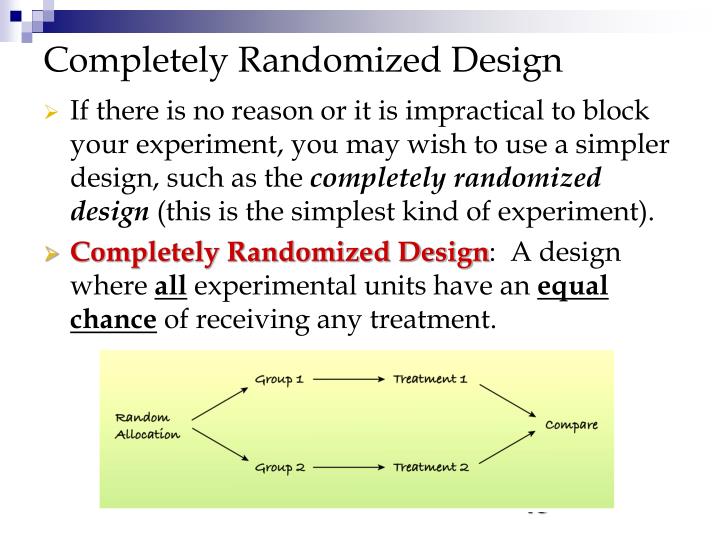
Randomization Procedure in Complete Random Design (CRD):
Assign Experiment Variants at Scale in A/B tests - Towards Data Science
Assign Experiment Variants at Scale in A/B tests.
Posted: Fri, 11 Feb 2022 08:00:00 GMT [source]
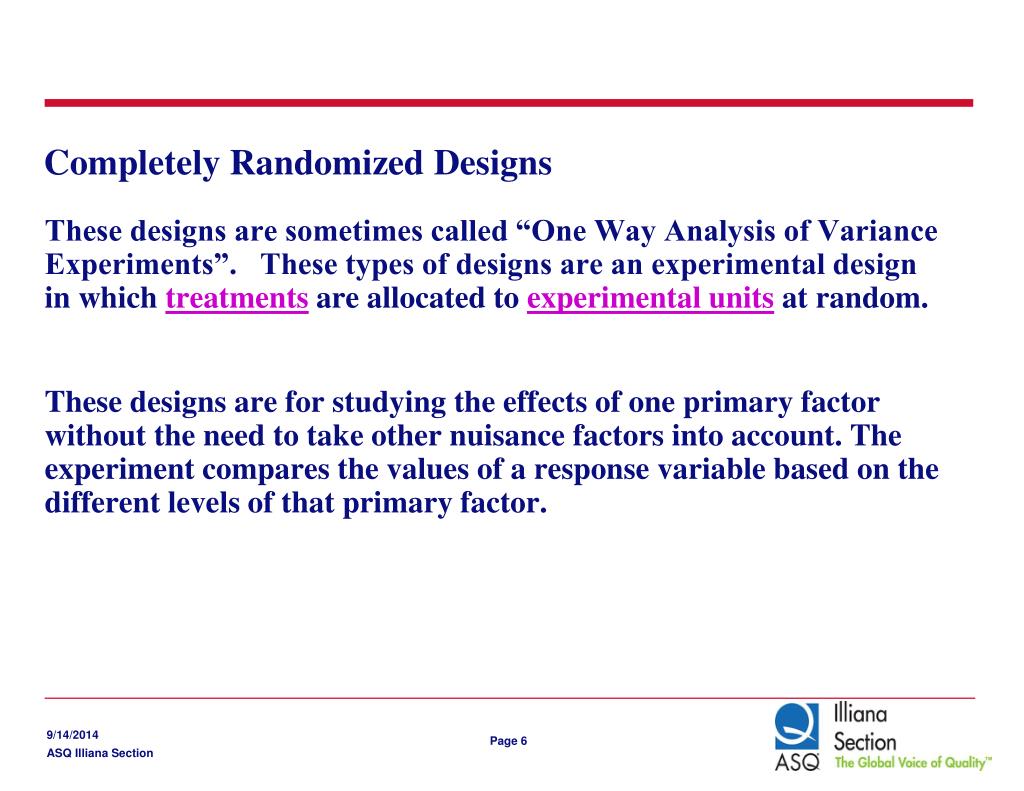
The completely randomized design (CRD) is the simplest of all experimental designs, both in terms of analysis and experimental layout. Here, treatments are randomly allocated to the experimental units entirely at random. Thus if a treatment is to be applied to five experimental units, then each unit is deemed to have the same chance of receiving the treatment as any other unit.
The treatment effects that we estimate withthe ANCOVA model in Equation (2.7) are condititionaltreatment effects (conditional on the same value of the covariate x). However, for a given realization, the usualANOVA estimate can be slightly biased because the covariate is not perfectlybalanced between the treatment groups. This is also called a conditional bias.This bias is typically small for a completely randomized design. Hence,in these situations, using the covariate is mainly due to efficiency gains, i.e.,power.
This scale is an adapted version of the Targeted Parent-Child Communication about Alcohol Scale, a measure with demonstrated reliability and validity [36]. Several dimensions are assessed including parental warnings about the dangers of drugs, advice for how to address drug situations such as offers or peer pressure, and articulation of rules and sanctions around drugs. Items are assessed on a six-point Likert scale from “Strongly agree” to “Strongly disagree”.
However, like other fields, the application of CRD in medical research has its limitations. Despite its effectiveness in controlling various factors, CRD may not always consider the complexity of human health conditions where multiple variables often interact in intricate ways. Hence, while CRD remains a valuable tool for medical research, it is crucial to apply it judiciously and alongside other research designs to ensure comprehensive and reliable insights into medical treatments and interventions. The fields of medical and health research substantially benefit from the application of Completely Randomized Design, especially in executing randomized control trials. Within this context, participants, whether patients or others, are randomly assigned to either the treatment or control groups. This structured random allocation minimizes the impact of extraneous variables, ensuring that the groups are comparable.
Its essence lies in the unbiased random assignment of experimental units to various treatments, ensuring the reliability and validity of the results. Although it may not control for other variables and often requires larger sample sizes, its ease of implementation frequently outweighs these drawbacks, solidifying it as a preferred choice for researchers across many fields. Unlike the straightforward approach of CRD, RBD divides experimental units into homogenous blocks, based on known sources of variability, before assigning treatments. This method is especially useful when there's an identifiable source of variability that researchers wish to control for.
The independence assumption is most crucial, but also most difficult to check.The randomization of experimental units to the different treatments is animportant prerequisite (Montgomery 2019; J. Lawson 2014). If theindependence assumption is violated, statistical inference can be veryinaccurate. If the design contains some serial or spatial structure, some checkscan be done as outlined below for the serial case.


No comments:
Post a Comment