Table Of Content
If we have simulated data for aheatmap, an additional column for that variable appears in the FieldBook. In the domain of business analytics, CRD is paving the way for robust analysis of business strategies and initiatives. Businesses can employ CRD to randomly assign strategies or processes across various departments or teams, allowing for a comprehensive assessment of their impact.
CRD in quality control analysis
People, places, species and scientific procedures have names which can be used to identify and describe a subject or a procedure. Experimental designs also have names; “Completely randomised”(CR), “Randomised block”(RB), “Latin square”, “Matched pairs” etc. These can be found in textbooks which describe the characteristics and uses of each design13. However, none of the papers in the above survey mentioned either the CR or the RB design by name, although these are the only designs suitable for general use.
SUPPER experimental condition
Furthermore, the utility of CRD in quality control extends to the analysis of materials, machinery settings, or operational processes that are pivotal to final product quality. This design enables organizations to rigorously test and compare assorted conditions or settings, ensuring the selection of parameters that optimize both quality and efficiency. This approach to quality analysis not only bolsters the reliability and performance of products but also significantly augments the optimization of organizational resources, curtailing wastage and improving profitability. CRD's implementation in industrial engineering also assists in the optimization of manufacturing processes. Through random assignment and structured testing, engineers can effectively evaluate process parameters, such as production speed, material quality, and machine settings.
Unlimited Design Service vs. Hiring a Freelancer

The CRD is often used if we believe that the experimental material is homogeneous or uniform. Usually, though not necessarily, the random assignment is restricted in such a manner as to have an equal number of experimental units assigned to each treatment. The CRD should therefore be used where extraneous factors can easily be controlled, such as in laboratories or green houses. The CRD is usually the choice design in pilot studies where experimental units and conditions are homogeneous. In the design of experiments, completely randomized designs are for studying the effects of one primary factor without the need to take other nuisance variables into account. This article describes completely randomized designs that have one primary factor.
According to Chambers Twentieth Century Dictionary (1972) the word “group” can mean “a number of persons or things together” or “a number of individual things related in some definite way differentiating them from others”. From the output, we can conclude that only the linear part is significant with avery small p-value. Hence, the conclusion would be that the data can bedescribed using a linear trend (which could also be used to interpolate betweenthe observed levels of pressure), and there is no evidence of a quadratic orcubic component. In that sense, such an ANOVA model is very close to an approachusing a linear regression model where we would treat pressure as a continuouspredictor. See also Section 2.6.2 for more informationthat ANOVA models are basically nothing more than special linear regressionmodels. On this data set, the result is very similar to the parametric approach ofaov.

Of course we could start analyzingthese residuals with methodology from time-series analysis. Similar problemsarise if the experimental design has a spatial structure. Then we could startanalyzing the residuals using approaches known from spatial statistics. In the greenhouse experiment discussed in Chapter 1, there was a single factor (fertilizer) with 4 levels (i.e. 4 treatments), six replications, and a total of 24 experimental units (each unit a potted plant). Suppose the image below is the Greenhouse Floor plan and bench that was used for the experiment (as viewed from above).
The effects of learning about one's own genetic susceptibility to alcoholism: a randomized experiment Genetics in ... - Nature.com
The effects of learning about one's own genetic susceptibility to alcoholism: a randomized experiment Genetics in ....
Posted: Thu, 30 Aug 2012 07:00:00 GMT [source]
Study timeline
Performance of Holstein calves receiving equal solids per day from high-solids milk and milk replacer blend once or ... - ScienceDirect.com
Performance of Holstein calves receiving equal solids per day from high-solids milk and milk replacer blend once or ....
Posted: Sun, 10 Jul 2022 06:06:32 GMT [source]
Parents/guardians in the control arm receive the same dose but with content focused on nutrition, physical activity, and weight stigma. Participant dyads submit videos of family meals, audio recordings of prompted conversations, and quantitative surveys over an 18-month period (baseline, 3, 6, 12, 18 months post-intervention). The project manager assigns the interventionist and sends the participants their respective condition materials. Too many pre-clinical experiments are giving results which cannot be reproduced. In “Completely randomized” (CR) and “Randomised block” (RB) experimental designs, both the assignment of treatments to experimental subjects and the order in which the experiment is done, are randomly determined.
Navigating common challenges in CRD
His method addressed the inherent variability in experimental units by randomly assigning treatments, thus countering potential biases. Today, CRD serves as an indispensable tool in various domains, including agriculture, medicine, industrial engineering, and quality control analysis. Interested parents are screened using a brief online survey that is administered by a research assistant over the phone. To be eligible, parents must be a custodial parent living with their child at least 50% of the time and child participants must be a student in 5th, 6th, or 7th grade and enrolled in school within Massachusetts. During summer-month recruitment (June through August), students entering 5th grade and those who just completed 7th grade are eligible.
Using the FielDHub function: CRD()
For example, researchers might use CRD to study the effects of different pollutants, conservation strategies, or land use patterns on ecosystem health. The randomized design ensures that the conclusions drawn are robust and reliable, providing a solid foundation for the development of policies and initiatives. As environmental concerns continue to mount, the role of reliable experimental designs like CRD in facilitating meaningful research and informed policy-making cannot be overstated. For example, to discern the impact of varying temperatures on the strength of a metal alloy, engineers might utilize CRD. In this scenario, the different temperatures represent the single factor, and the alloy samples are randomly allocated to be tested at each designated temperature. This random assignment minimizes the influence of extraneous variables, ensuring that the observed effects on alloy strength are primarily attributable to the temperature variations.
Remote visits were implemented as a permanent option for the remainder of the study. An electronic copy of the consent and assent forms are emailed to the dyad prior to the visit. During the meeting for both in-person and remote options, informed consent/assent are obtained from the participants before beginning data collection. Demographic data from both parent and child are collected via an online survey. Research assistants then review the procedures for using a study-provided iPad to record and upload conversations and family meals that they are to complete and upload independently during the baseline and follow-up visits. This is a novel, brief, communication-focused intervention for parents/guardians that was designed to reduce participant burden.
Engaging in educational opportunities, staying abreast of the latest research and advancements, and actively participating in pertinent discussions and forums can markedly enrich understanding and expertise in CRD. Embracing this ongoing learning journey will not only bolster individual research skills but also make a significant contribution to the broader scientific community, fueling innovation and discovery in numerous fields of study. The test statistic different for the same null hypothesis under the fixed effects model. We have \(a\) groups where the last group is the control group, and the \(a-1\) treatment groups. Tests on a single treatment mean, two treatment means, and contrasts can all be considered form the same perspective. We first load the data and make sure that pressure is encoded as an orderedfactor.
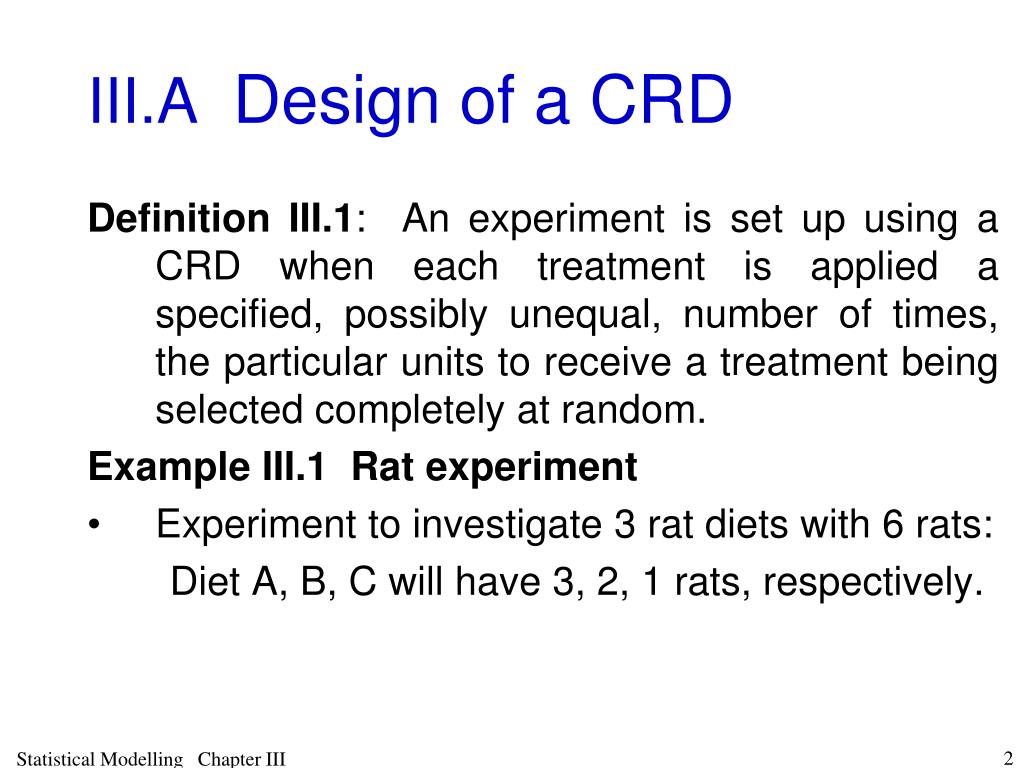
IPads are provided to the participants during baseline (or mailed prior to baseline when baseline is virtual) to complete all study-related activities. In CRD, as the name suggests, treatments are assigned completely randomly so that each treatment unit gets the same chance of receiving any one treatment. This is suitable only for the experiments such as laboratory experiments or greenhouse studies etc, where the experiment material is homogeneous and not for heterogeneous studies.


No comments:
Post a Comment